
As technology teams head into Q4 planning, many are facing a familiar challenge: there is more work to get done, but not always a clear answer for how to resource it.
A new Salesforce initiative may need specialized developers. A modernization project may require several technical skill sets working together. An AI or data initiative may still need a clearer roadmap before execution can begin.
In each case, adding people may help. But adding people is not always the same as solving the delivery problem.
Deloitte’s 2026 Global Technology Leadership Study found that 79% of technology leaders rank driving business outcomes as a top priority, while 75% say their operating model needs to fundamentally change to create greater value.
For technology leaders, the workforce decision is increasingly about more than headcount. The better question is: What does this initiative actually need to move forward?
In some cases, the answer is added capacity. In others, it is project ownership. And for initiatives that are still taking shape, it may be strategic guidance before significant time or budget is committed.
Understanding those differences can help organizations choose the right technology delivery model from the start.
Which model fits the work?
- Staff augmentation: You know what needs to get done and need additional technical capacity.
- Project-based delivery: The initiative is defined, but you need a partner to manage and deliver the work.
- Advisory & Consulting: You need help defining the strategy, roadmap, or approach before execution begins.
Start With What the Initiative Actually Needs
Technology workforce solutions can take many forms, but most needs fall into three broad categories: additional execution capacity, ownership of a defined initiative, or guidance on what should happen next.
That is a more useful starting point than jumping directly to job titles or headcount.
Staff Augmentation: Add the Expertise Your Team Is Missing
Staff augmentation remains an effective option when an organization knows what needs to happen but needs additional capacity or specialized expertise to get there.
A company may need a Salesforce developer ahead of a major release, a data engineer to support an expanding analytics program, or a project manager to provide additional bandwidth during a particularly busy period. Contract talent can step into those gaps quickly and work alongside the existing team, giving organizations another option for flexible workforce planning as priorities and workloads change.
The American Staffing Association reported that temporary and contract staffing employment for the four weeks ending August 16, 2026, was 4.4% higher than during the same period in 2025.
The important distinction is ownership. With staff augmentation, the organization still manages priorities, assigns work, handles dependencies, makes key decisions, and remains responsible for the overall result.
This approach is often a good fit when:
- The scope and priorities are already established
- Internal leaders have the bandwidth to manage the work
- A specific technical skill is missing
- Additional capacity is needed quickly
- The workload is temporary or likely to fluctuate
- The organization wants to scale without immediately adding permanent headcount
For example, a Salesforce team may need another developer and QA specialist before a major release, while an application team may need cloud engineering expertise during a modernization effort. In each case, the organization continues to lead the work while outside talent provides the specialized expertise or capacity needed to move it forward.
The number of people involved does not determine whether an engagement is staff augmentation or project delivery. Even a dedicated team may still work under the client’s direction. The more important distinction is who is responsible for managing the work and delivering the outcome.
Project-Based Delivery: Put More Ownership Around the Work
When internal teams are already stretched, timelines are fixed, or an initiative requires several disciplines to work together, adding more technical resources may not solve the underlying challenge.
Project-based delivery shifts more responsibility to a delivery partner. Instead of organizing the engagement around individual positions, the work is structured around a defined initiative, scope, or business outcome, with the partner helping manage execution, timelines, governance, and budget.
Project-based delivery may be a stronger fit when:
- There is a defined project or business outcome
- Multiple technical skill sets need to work together
- Internal leaders cannot absorb additional project management
- The initiative has firm milestones or deadlines
- Dependencies create meaningful delivery risk
- Leadership wants greater accountability from an external partner
Examples could include a Salesforce integration, application modernization effort, data initiative, cloud program, infrastructure project, or another technology transformation with clearly defined goals.
That need for stronger ownership becomes even more important as technology environments grow more complex. Gartner’s 2026 analysis of technology adoption found that architectural complexity was the top adoption barrier across 35% of the technologies it evaluated. Gartner also notes that even strong architecture practices can fall short without clear ownership and governance.
For high-priority initiatives, adding technical capacity may only address part of the challenge. The organization may also need a partner that can coordinate the work, manage dependencies, and take greater responsibility for delivery.
Advisory & Consulting: Define the Path Before You Build the Team
Not every technology challenge is ready for execution. Leadership may understand the business problem without knowing the best technical path forward.
A platform may need modernization, but the roadmap is still unclear. An AI opportunity may require a better understanding of data readiness and governance. Or a complex Salesforce environment may need to be reassessed before more development is added.
Hiring into that uncertainty can create unnecessary cost and rework.
Advisory and consulting support can be especially valuable in these earlier-stage decisions. The focus is on helping organizations align technology choices with the business outcome they are trying to achieve.
Depending on the situation, that may include:
- Clarifying requirements and priorities
- Evaluating technology options
- Identifying technical or operational risks
- Developing the roadmap and project scope
- Determining the skills and resources execution will require
This becomes particularly important when the investment is significant or the organization is entering unfamiliar territory.
Deloitte’s 2026 research found that 42% of surveyed technology leaders reported low or no ROI from AI investments. For organizations considering major AI, automation, data, or transformation initiatives, taking time to define the right approach before building the right technology team can reduce the risk of investing heavily in the wrong direction.
Staff Augmentation vs. Project Delivery vs. Consulting
Primary Need
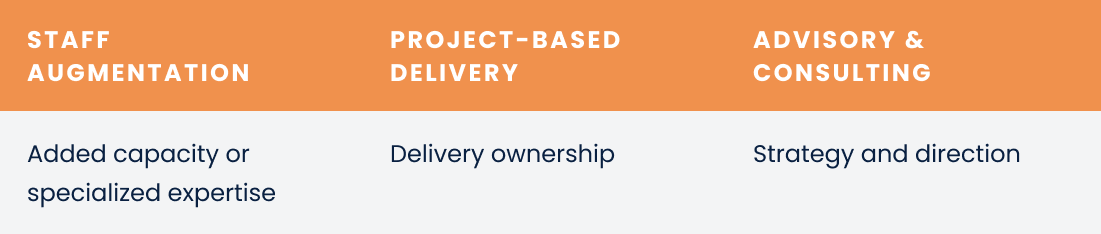
Who directs the work?
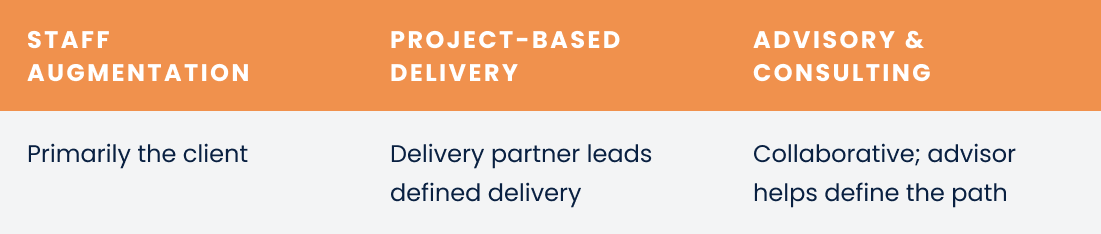
Best fit

Typical support

Example
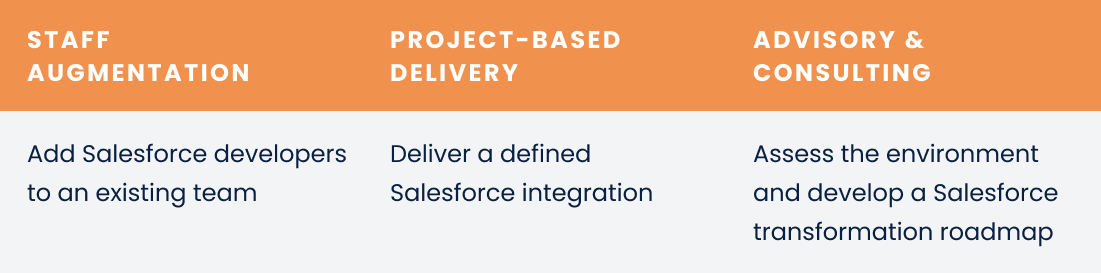
These models are not competing solutions. They solve different problems.
A capable technology partner should be able to recognize those differences rather than trying to fit every initiative into the same type of engagement.
When the Need Has Moved Beyond Additional Capacity
Knowing when to shift models is not always obvious. These are some of the clearest signs that the challenge may extend beyond adding technical talent.
1. Leadership is focused on the deliverable, not the headcount
If the conversation has moved from “We need two developers” to “This implementation has to be live by December,” the nature of the problem has changed.
The business is now measuring success against an outcome.
That does not automatically mean staff augmentation is the wrong model, but it does mean delivery ownership should be part of the discussion.
2. Your internal team does not have the bandwidth to manage more resources
Adding people also adds management.
Someone still needs to set priorities, coordinate work, monitor progress, address issues, and keep the initiative aligned with the business. If technology leaders are already stretched across operations and transformation priorities, adding more resources without adding project ownership can create another management burden.
3. The initiative requires several capabilities working together
Large technology initiatives rarely require just one type of expertise. A modernization program may involve architecture, engineering, data, QA, project management, and change management at different stages.
If the organization does not have the bandwidth to integrate and manage those capabilities internally, structuring a project team around the initiative may be more effective.
4. A missed deadline has significant business consequences
Some technology projects are directly connected to revenue, customer experience, compliance, an acquisition, operational efficiency, or another critical business priority.
As the consequences of a delay increase, the need for clearly defined ownership, milestones, governance, and escalation tends to increase with it.
That is often the point where the engagement model deserves another look.
5. You are discussing job titles before agreeing on the solution
This is one of the easiest warning signs to miss.
If stakeholders are debating whether to hire a cloud architect, developer, data engineer, or project manager before the technical roadmap is clear, it may be worth asking whether staffing is the fix yet.
The organization may need to solve the strategy problem first.
Getting the direction right first can make the eventual workforce decision much easier and help avoid investing in skills that do not match the final solution.
The Right Model May Change Over the Life of the Initiative
Technology initiatives do not always stay within one engagement model. An organization may begin with advisory support to define the roadmap, move into project-based delivery for implementation, and use staff augmentation or embedded specialists after launch to maintain momentum.
The progression can work in the other direction too. A company may start with one or two contractors and later determine that the work has grown complex enough to require dedicated project management and clearer delivery accountability.
The point is to let the business need determine the model, rather than trying to fit the work into the type of service a vendor happens to provide.
Questions to Ask During Q4 Technology Planning
As organizations finalize year-end priorities and begin planning for 2027, a few questions can help identify the right approach:
- Is the desired business outcome clearly defined?
- Do we have the internal leadership and bandwidth to manage the work?
- Are we missing specific skills, or an entire delivery capability?
- Does the initiative have firm deadlines, budgets, or business milestones that increase delivery risk?
- Do we know what needs to be built, or do we still need help defining the path?
Those answers can help determine whether the immediate need is additional talent, greater delivery ownership, or strategic guidance.
Build the Engagement Around the Work, Not the Other Way Around
Technology workforce needs are becoming more varied, and the answer is not always another hire. The important thing is to start with the work itself: what needs to be accomplished, how much ownership the internal team can realistically take on, and where outside expertise can have the greatest impact.
That is also why CSS Tec has expanded beyond a traditional technology staffing model.
CSS Tec supports technology initiatives across three areas: Advisory & Consulting when organizations need direction, Solution & Project Delivery when the work requires greater ownership and accountability, and Talent-Powered Execution when the priority is putting the right technical expertise in place quickly.
Rather than forcing every technology challenge into the same engagement model, CSS Tec starts with the work and helps determine what kind of expertise, ownership, and delivery support it actually requires.
Across Salesforce, application development, data and AI, infrastructure, and broader transformation initiatives, the goal is the same: put the right expertise and level of ownership around the work.
Because the right technology talent matters. So does choosing the right way to put that talent to work.
Need Help Determining the Right Delivery Model?
CSS Tec can help you evaluate whether your initiative calls for strategic advisory, project-based delivery, specialized technology talent, or a combination of approaches. Talk to a Technology Advisor